

Drop Treatment
Drop Treatment treatment in Haldwani
Foot drop, which is also sometimes called a dropped foot, is a condition in which it is difficult to lift up the front part of your foot. As a result your forefoot and toes tend to catch or drag on the floor as you walk. It can be temporary or permanent and most commonly affects one side only.
The gait of foot drop may involve:
- As you walk along, the affected foot (or feet) catches on the floor.
- As you walk along you lift the leg high to avoid the foot catching (high stepping gait). People who do this often tend to walk on tiptoe on the other side to equalise the sides.
- As you walk you swing the affected leg out to the side to avoid it catching on the floor.
Foot drop usually affects just one foot. However, it can affect both sides, either equally or to different degrees. It may be temporary or permanent.
There are several grades of foot drop. These are measured from 0 to 5 depending on the degree of strength and movement there is in the muscles which lift the foot. 5 is normal strength and 0 is total paralysis.
Causes
All causes of Bell’s palsy are not known. It may occur when a virus, such as the common cold, makes your facial nerve swell. The swollen nerve presses against the bone around it. This pressure can stop the nerve from working correctly.
You may be more likely to get Bell’s palsy if you are between 15 and 60 years of age or have one of the following:
- Herpes
- Diabetes.
- A common cold.
- The flu.
- High blood pressure.
- Lyme disease.
- Mononucleosis
- HIV or another autoimmune disorder.
- Sarcoidosis.
- Head trauma.
Bell’s palsy affects about 1 in every 5,000 people. Once you have had Bell’s palsy, you have a slight chance of getting it again
Symptoms
People who have foot drop may drag their toes when they walk. They may also have to lift their knees higher than usual to avoid dragging their toes. Other symptoms include muscle weakness and “tingling” feelings in the leg.
Diagnosis
Foot drop is usually diagnosed on examination. Your doctor will watch you walk and may check your leg muscles for weakness. They will also assess nerve function by checking your reflexes and the sensation in the skin.
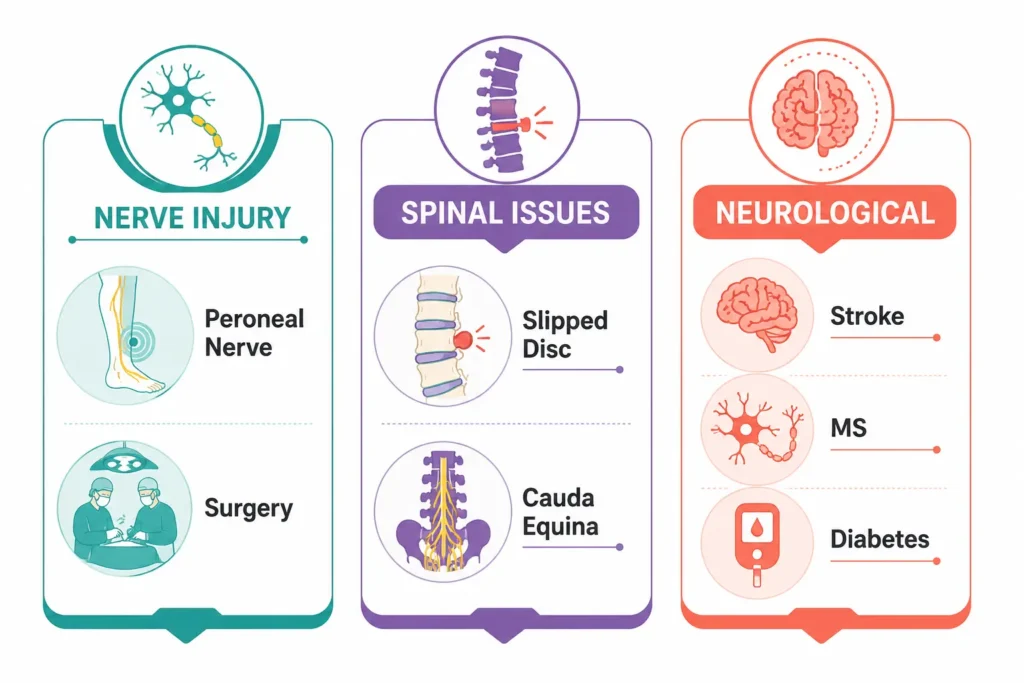
Foot drop is a symptom rather than a diagnosis and your doctor will want to understand what has caused it. Investigations for the cause of foot drop may include:
- X-rays — may be used to look for a soft tissue growth or a bone abnormality that may be causing your symptoms.
- Ultrasound — may be used to check for cysts or tumours that may be pressing on the nerve.
- Computerised tomography (CT) scan — can be used to look for growths (masses) or other changes anywhere in the body.
- Magnetic resonance imaging (MRI) — particularly useful in visualising soft tissue lesions that may be compressing a nerve, such as a ‘slipped’ disc in the back. It can also examine the brain for the characteristic lesions of MS.
- Electromyography (EMG) and nerve conduction studies — measure electrical activity in the muscles and nerves to look for the location of the damage along the affected nerve.
Foot Drop Treatment in Haldwani at Healthcapes
Once the underlying cause of your foot drop has been identified, we build a treatment plan around it. This typically includes physiotherapy focused on strengthening the muscles that lift the foot, gait training to reduce fall risk, and stretching to maintain flexibility. Depending on the cause, this may be combined with treatments like Deep Tissue Laser Therapy or Manipulation & Mobilization, working alongside your doctor’s care where an underlying condition needs medical management.
