




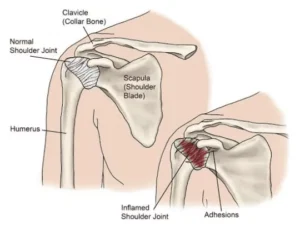
Adhesive capsulitis is commonly called frozen shoulder. This occurs when the joints in your shoulder are inflamed. The inflammation leads to scar tissue. This prevents you from being able to move your shoulder in all directions without pain. Your shoulder can become stiff, and it may be difficult for you to move it at all.
Symptoms of adhesive capsulitis
The primary symptom is difficulty moving your shoulder without pain and stiffness. You may feel this when you:
- Reach up toward the sky with both arms.
- Reach your arms out straight in front of you.
- Raise your arms out to the sides of your body.
- Try to unzip the back of your dress or pull your wallet from the back pocket of your pants.
At first, your shoulder may ache and feel stiff. Then it may get very painful. This is called the painful stage. It may last about 3 to 8 months. The second stage is called the adhesive stage. You may not have as much pain. However, your shoulder keeps getting stiffer. This stage usually lasts about 4 to 12 months. By the time you reach the final stage, it becomes very hard to move your shoulder, even a little bit. This stage usually lasts about 1 to 3 months. However, it isn’t very painful. Eventually, the stiffness slowly goes away. You can move your shoulder again. You may not get the full movement of your shoulder back. As your shoulder movement increases, you may still have pain at times. However, you should be able to do more activities.
What causes adhesive capsulitis?
This condition develops when the tissue in your shoulder joint tightens and restricts movement. This occurs when you are not active because of another injury, such as a rotator cuff injury, broken arm. Also, it happens when you use your shoulder the wrong way. Certain risks factors can increase frozen shoulder. Risks are higher for:
- People 40 years of age and older.
- Women
- People with diabetes.
- People with thyroid problems.
- People experiencing hormonal changes (more likely during menopause).
- People who have had open-heart surgery.
- People with cervical disc disease of the neck.
How is adhesive capsulitis diagnosed?
Your doctor may be able to diagnose a frozen shoulder just by talking to you about your symptoms and watching you move your shoulder. During an exam, your doctor may press on parts of your shoulder to see what might be causing the pain. Your doctor may also want to take an X-ray or do a magnetic resonance imaging (MRI) scan of your shoulder to look for other problems.