
Ankle Sprain
Ankle Sprain Treatment in Haldwani
Ankle Sprain Treatment in Haldwani at Healthcapes helps patients recover from injury to one or more ligaments in the ankle, usually on the outside. Ligaments work like rubber bands, connecting bone to bone and keeping the joint stable by limiting side-to-side movement. When they’re stretched or torn, that stability is compromised, and it’s worth knowing that a sprain affects ligaments, not muscles, which is what separates it from a strain.
Grading Ankle Sprains
Ankle sprains are graded by severity:
- Mild (Grade I) — ligaments are stretched but not torn. The ankle still feels stable, with some pain and stiffness.
- Moderate (Grade II) — one or more ligaments are partially torn. The joint isn’t fully stable, movement is limited, and there’s swelling with moderate pain.
- Severe (Grade III) — one or more ligaments are completely torn, leaving the ankle unstable, with significant pain and very limited movement.
What Causes an Ankle Sprain
Sprained ankles typically result from a fall, a sudden twist, or a blow that forces the joint out of its normal position. This commonly happens during sports, while wearing unsuitable shoes, or walking or running on uneven surfaces. Some people are simply born with weaker ankles, and previous ankle or foot injuries can further weaken the joint, increasing the risk of future sprains.
Symptoms of an Ankle Sprain
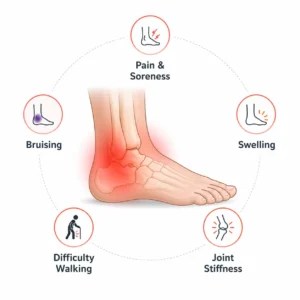
Common symptoms include:
- Pain or soreness
- Swelling
- Bruising
- Difficulty walking
- Stiffness in the joint
It’s worth noting that ankle fractures are often mistaken for sprains, though the two are quite different and sometimes occur together, which is why an accurate, early diagnosis genuinely matters.
Risk Factors for Ankle Sprains
Certain groups are more prone to ankle sprains, including women, children, and teenagers. Your risk may also be higher if you:
- Play sports, especially on an indoor court
- Have balance problems
- Wear high heels or poorly fitting shoes
- Have weak or stiff ankles, such as from a previous injury
How We Diagnose Ankle Sprains at Healthcapes
Diagnosis begins with a thorough discussion of your symptoms and how the injury happened, along with a physical examination of the foot and ankle. We may recommend an X-ray or other imaging to determine the severity of the injury and rule out an associated fracture.
Ankle Sprain Treatment in Haldwani at Healthcapes
Once we understand the grade and severity of your ankle sprain, we build a treatment plan around it. This typically includes physiotherapy to restore stability, strength, and range of motion, along with therapies like Deep Tissue Laser Therapy to reduce swelling and support ligament healing. We also focus on balance and proprioception training, since this plays a key role in preventing repeat sprains once you return to normal activity.
Frequently Asked Questions
This depends on the grade. Mild sprains may improve within one to two weeks, while severe (Grade III) sprains can take several weeks to months of guided rehabilitation.
The symptoms can look similar, which is exactly why a proper assessment, sometimes including an X-ray, is important to confirm which one you’re dealing with.
This depends on severity. Mild sprains may allow some weight-bearing, while moderate to severe sprains often require rest and support before returning to full activity.
Balance training, proper footwear, and strengthening the muscles around the ankle can meaningfully reduce your risk, especially if you’ve sprained your ankle before.