
Posture Correction Treatmen
Posture Correction Treatment in Haldwani
Posture Correction Treatment in Haldwani at Healthcapes starts from a simple truth: the way you hold your body every day quietly shapes how you feel, move, and even how confident you come across. Good posture supports better physical performance and a healthier-looking frame, while poor posture, most commonly seen as slouching, gradually increases the risk of chronic pain and certain health issues. Almost everyone has fallen into that “comfortable” slouched position at a desk or in class at some point, but over time, that habit can catch up with you.
What Is Posture, Really?
Posture is simply how you hold your body upright against gravity, whether you’re standing, sitting, or lying down. Good posture means your joints are correctly aligned in a natural position, placing the least possible stress on your body. Poor posture means you’re out of alignment, placing excess strain on specific muscles and joints.
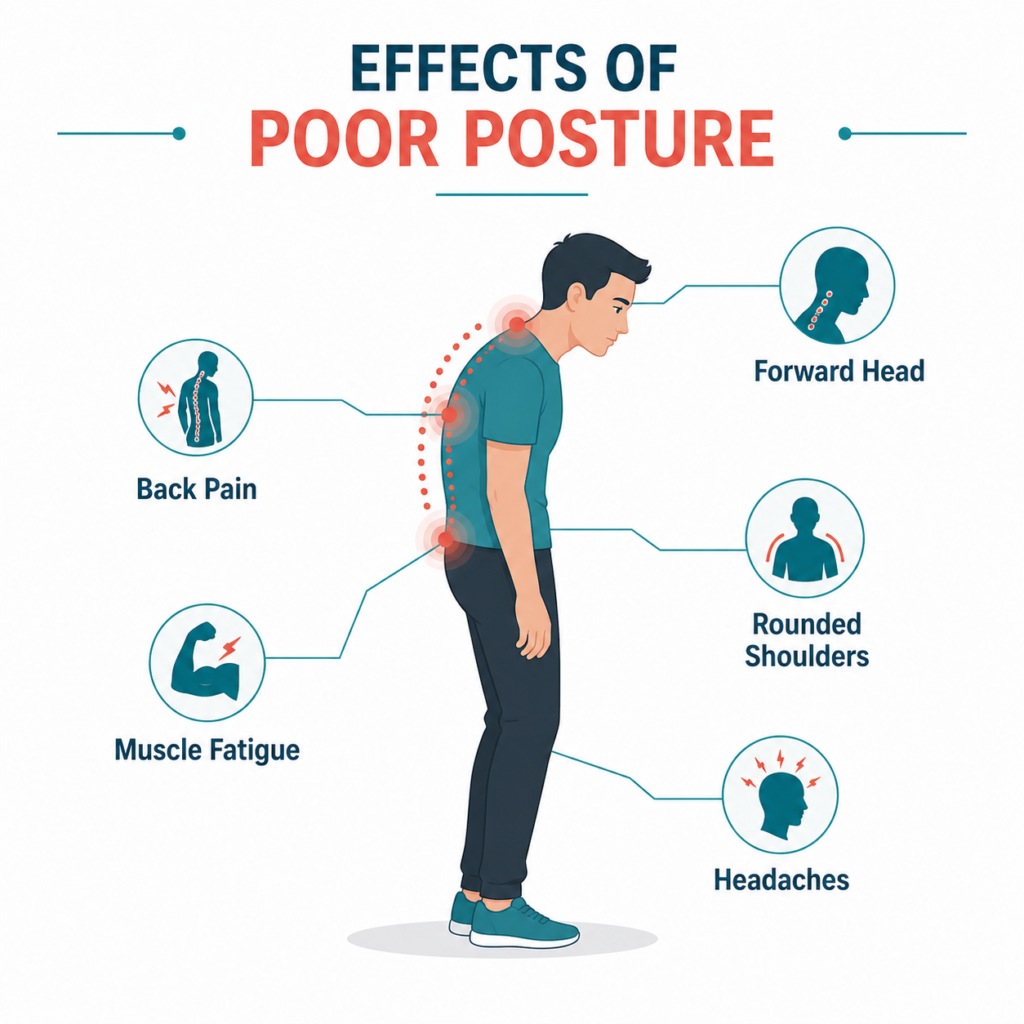
Holding poor posture consistently over time can lead to lasting changes in how your body functions, including:
- Muscle length and strength — under-used supporting muscles gradually weaken and shorten, which can compress the vertebrae
- Muscle fibre balance — your body relies on both static muscles (which stabilize posture) and phasic muscles (used for movement). Poor posture over-relies on phasic muscles, leading to fatigue
- Nervous system feedback — your muscles constantly relay position information to your brain. When static muscles aren’t properly engaged, this feedback becomes incomplete, contributing to further fatigue and pain
Signs You Might Have Poor Posture
Common indicators include:
- Back pain
- Random aches in joints and muscles
- Ongoing muscle fatigue
- Rounded shoulders
- A protruding “potbelly”
- A head that leans forward or backward
- A curved neck
- Headaches
What Healthy Posture Looks Like
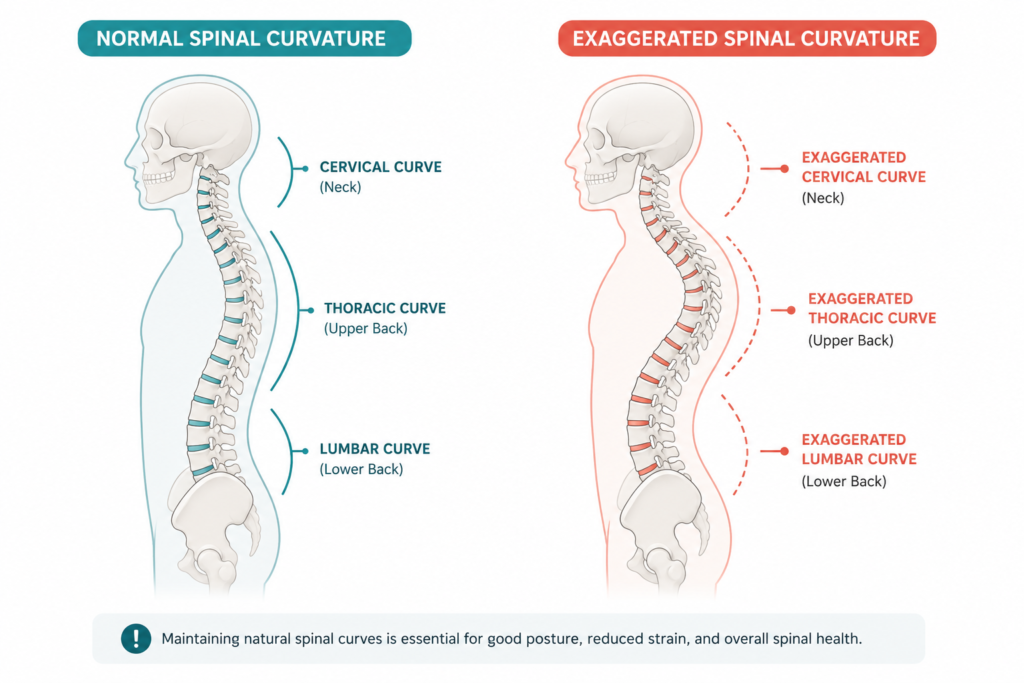
In someone with well-aligned posture, viewed from the side, the ears sit directly above the shoulders, the shoulders line up with the hips, and the hips line up with the ankles. A healthy spine has three natural curves: the cervical curve of the neck, the thoracic curve of the upper back, and the lumbar curve of the lower back, each falling between roughly 20 and 40 degrees.
Common Posture Problems We See
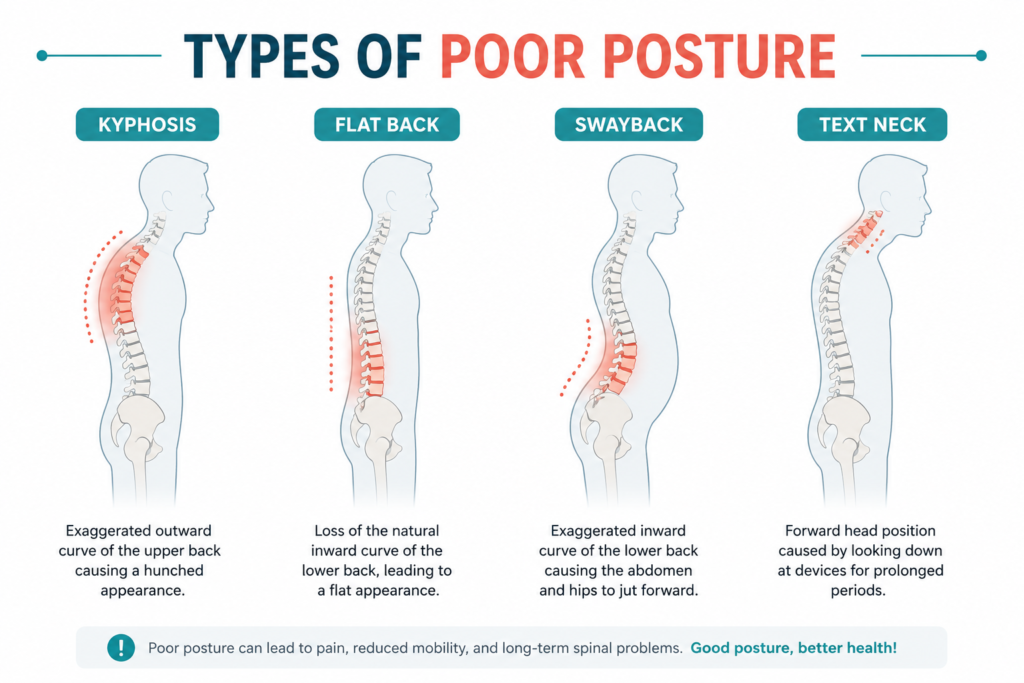
Kyphosis
A more pronounced spinal curve, sometimes exceeding 50 degrees, typically presenting as a forward head position, an exaggerated neck curve, rounded shoulders, and excessive curvature between the upper and lower back.
Flat Back
Loss of the natural curve in the lower spine, which often causes the head to lean forward and the shoulders to stoop.
Swayback (Lordosis)
An exaggerated inward curve in the lower back and neck, which can contribute to back pain and limited movement. Often accompanied by a protruding stomach and buttocks.
Forward Head Posture (Text Neck)
The head sits noticeably ahead of the body’s natural alignment, creating tension in the neck and shoulders and frequently causing headaches. This is one of the more common posture issues we see, especially with heavy phone and screen use, and it typically responds well to a combination of physiotherapy and targeted exercises.
Can Posture Be Corrected?
Yes, in most cases. Awareness of your posture, combined with understanding healthy movement patterns, goes a long way toward correcting it consciously. At Healthcapes, our physiotherapists can further support this with targeted exercises to strengthen your core postural muscles, along with practical guidance on better positioning during work and daily activities to reduce your risk of injury.
Everyday Habits That Support Better Posture
While sitting at a desk:
- Keep feet flat on the floor or a footrest
- Avoid crossing your legs; keep ankles roughly in front of your knees
- Leave a small gap between the back of your knees and the seat
- Keep knees at or below hip level
- Support your lower and mid-back with your chair’s backrest
- Relax your shoulders, forearms parallel to the ground
- Avoid staying in one position too long; take regular movement breaks
While standing:
- Distribute weight through the balls of your feet
- Keep knees slightly bent
- Keep feet roughly shoulder-width apart
- Let arms hang naturally at your sides
- Stand tall with shoulders pulled back and down
- Keep your stomach gently engaged
- Keep your head level, earlobes in line with your shoulders
While lying down:
- Choose a mattress that genuinely feels comfortable for your body
- Use a pillow suited to your sleeping position
- Avoid sleeping on your stomach
- If sleeping on your side, place a pillow between your knees; if on your back, keep a pillow under your knees
Posture Correction Treatment in Haldwani at Healthcapes
Once we understand your specific posture pattern, whether that’s kyphosis, forward head posture, or a flattened lower back curve, we build a treatment plan around correcting it. This typically includes physiotherapy focused on strengthening weakened postural muscles, along with therapies like Deep Tissue Laser Therapy or Manipulation & Mobilization to ease related pain and tension. We also work with you on practical, everyday adjustments, so improvements last well beyond your sessions.
Frequently Asked Questions
Yes. Prolonged poor posture places excess strain on muscles and joints, which commonly leads to back pain, headaches, and muscle fatigue over time.
This varies depending on how long the pattern has been present and its severity, but consistent physiotherapy and daily habit changes typically show gradual improvement over several weeks to months.
While usually not dangerous on its own, forward head posture from prolonged phone or screen use can lead to ongoing neck tension and headaches if left unaddressed
Some improvement is possible with awareness and home exercises, but a proper assessment helps identify your specific pattern and ensures you’re strengthening the right muscles effectively.